
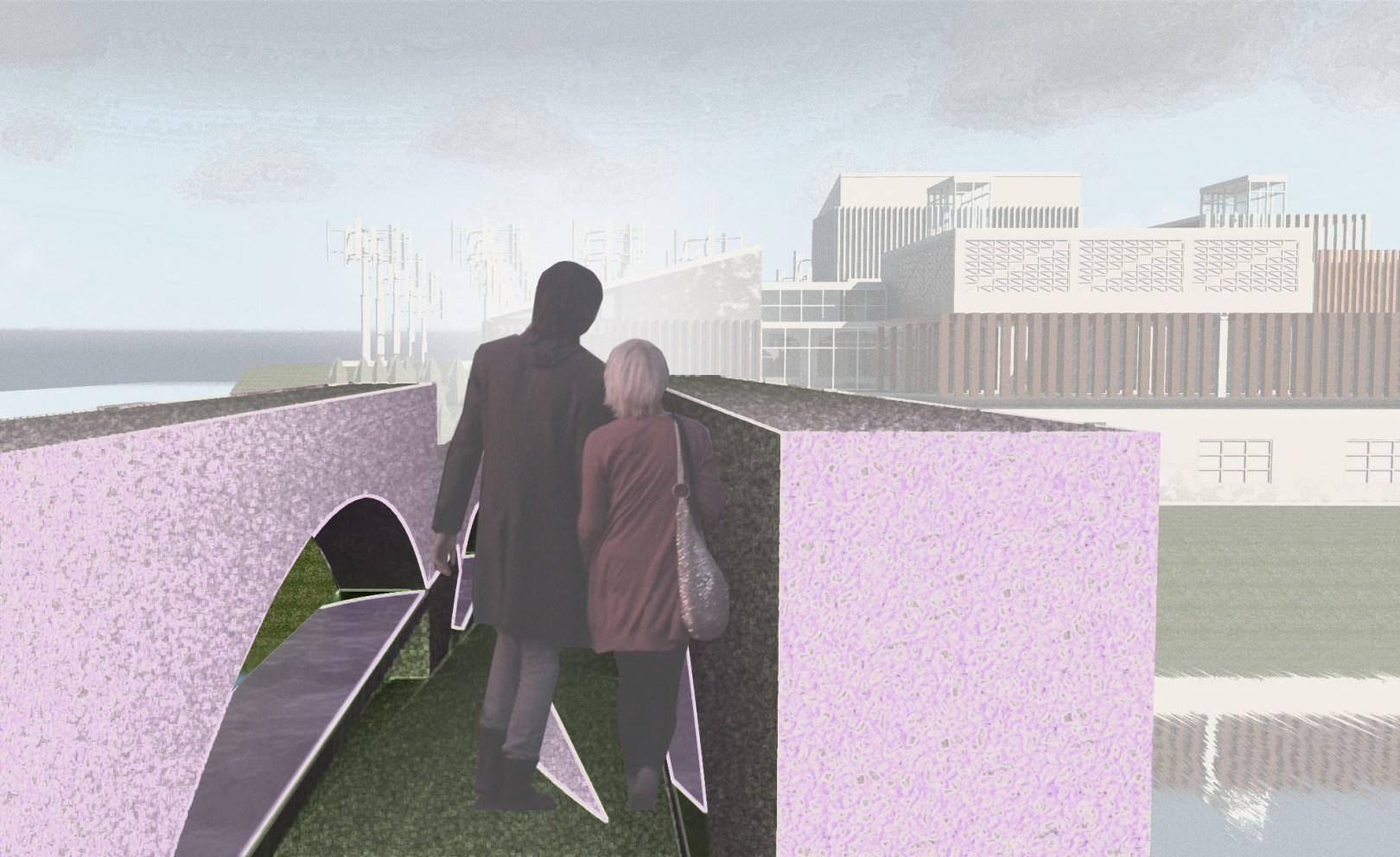
New York’s true gem is its magnificent skyline, however on the banks of Manhattan, the view of New York City to the left is pretty bland. People standing on the Manhattan side should have the same or similar experiential views as the users on the bank of Brooklyn experiencing the proposed site. While training/educating people in the trade of green technology, the Green Workforce Training Center (GWTC) elevates its envelope and topography to create a miniature city skyline on its campus. The building’s elevation and form also celebrates and emphasizes nature’s renewable resources to power the built environment, through photovoltaic and wind turbine technology, passive systems, and biophilia.


These three diagrams describe the design strategies and tactics used to achieve GWTC overall servicing purpose and design goals. Initially, the final design consisted of a series of separate buildings at different heights, more like the literal concept of a city and its skyline of skyscrapers. However because of the weather elements on the East Coast, a closed in campus with a series of buildings joined together by circulation and common spaces, wrapped in, through, and around with an envelope, and overlaid with green outdoor spaces create an improved learning environment. For passive systems to effectively perform, the population/grouping of spaces needed to be elevated at specific point in order to allow natural ventilation within the interior spaces of GWTC. The second diagram shows in purple, that there are at least four elevation changes. To enhance natural ventilation on site, the actual site begins to carve away and meet some of the elevation changes. This design move forces GWTC to appear as if it is floating or hovering over the Hudson Bay/River. With the programming of spaces and zoning mapped out, the last move needed to incorporate the green technology that GWTC intends to showcase to the public and train its students how use it. In the areas when the wood trellises and curtain walls are found, solar energy will be collected through built in photovoltaic strips on the wood. On certain areas of the building where the roof slopes, GWTC collects and harvest rainwater which channels from the sloped roof, through a series of pipes, and directly stored in the cistern or stilts that hold the different elevations of the building.


 alexiscflowers.com