
For my first studio course of graduate school, the instructor asked the studio to do three projects. The first two projects consisted of studying materials, surfaces, and wall systems that would lead to designing an overall comprehensive building typology with performance systems in the third project. Project one required the students to research a given precedent and pin pointing their building’s envelope, materiality, construction, and performance. I was given the Unilever Headquarters in Germany, who used Ethylene Tetrafluoroethylene (ETFE) instead of glass as a result of the material’s higher thermal performance, span, and strength against high winds. The company wanted a more transparent appearance among its surroundings, for many of their loyal customers failed to identify their name with their products. Unilever requested that their new headquarters would be designed in a way to physically make the statement to their consumers that “whatever the customer wants, we are here to service you.” The company also wanted to be able to open the windows and doors without the high winds from the harbor rustling paper in the interior office buildings..In this instance, the ETFE acts as an outer layer of a double facade system in order to block exterior high winds, while the inner layer of regular glazing is open to receive fresh air.

![wall section lines 3 [Converted]](https://i0.wp.com/alexiscflowers.com/wp-content/uploads/2016/02/wall-section-lines-3-converted.jpg?w=702&h=908&ssl=1 "wall section lines 3 [Converted]")


After the students researched their given project, they were asked to find other precedents similar to the given precedent depending on what aspect of the given precedent they enjoyed most. I did fully enjoy the thermal performance of the Unilever Headquarters in terms of the double layer facade. Therefore, I looked for a precedent that actually used the ETFE double facade to heat and cool the building. In my search, I came across the Water Cube in Beijing, China, who used an ETFE double facade to heat and cool the pool along with its circulation, seating, and other servicing spaces. As the the sun heat the facade, the pillows expand and trap the hot air inside the cavity until it is released into the interior space, and the pillow contract as the air inside the cavity is cooled. Throughout the day, the color of the facade also changes depending on the temperature and climate conditions; while at night, the facade glows with different color lights which are printed and incorporated into the ETFE surface.
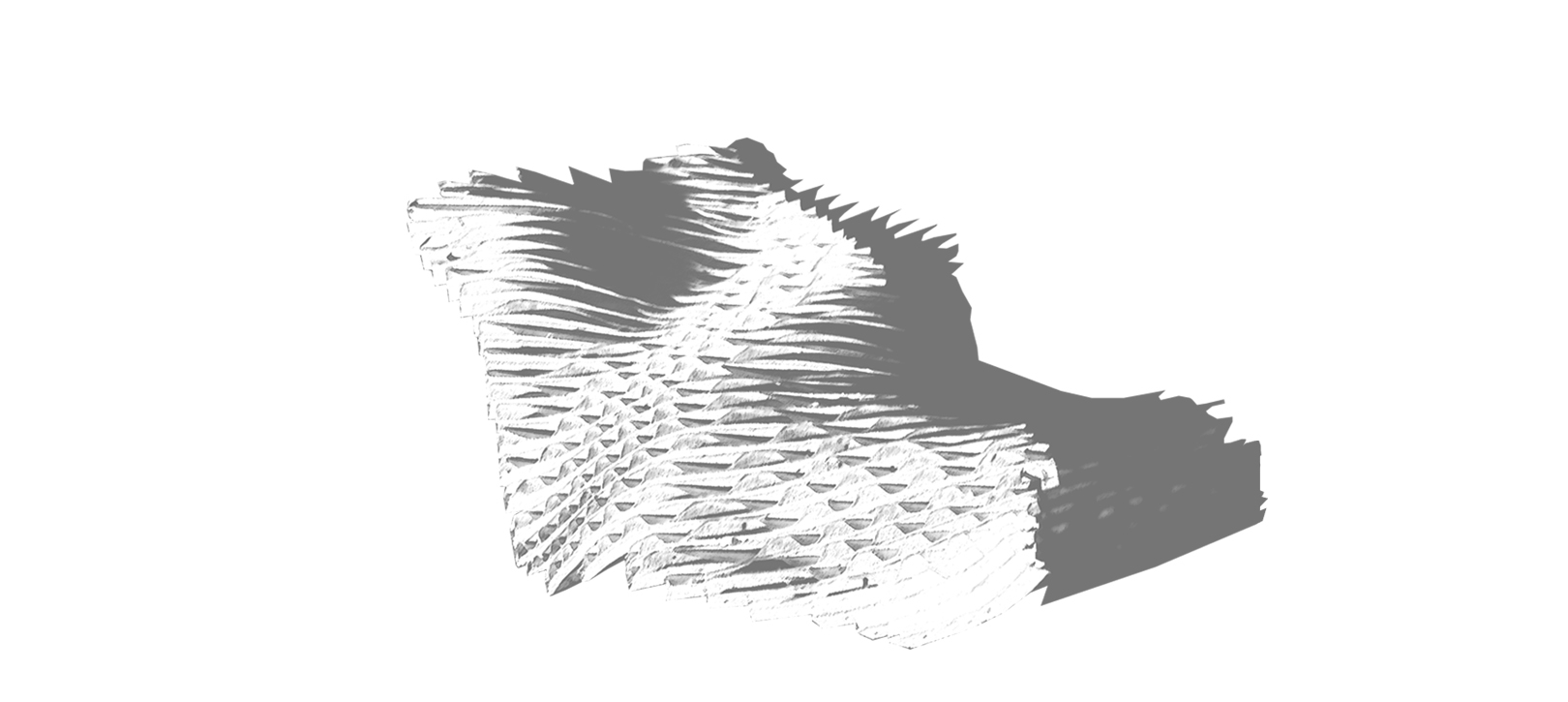
Comparing the thin layer of ETFE to the ETFE pillows, I decided to use the ETFE pillows for I believed the pillows provided more opportunity for my own surface manipulations in phase 2 of the semester long project. While studying the Water Cube, I did notice that the pillows needed a structural grid system in order for the pillows to expand and contract. To mimic my research, I initially started designing and testing out different structural grids. From this study I wanted to know which type of grid worked best for the overall system of ETFE pillows, one consistent structural grid or one of a free framework. After deciding on a structural grid system, I looked at the surface performing as a roof to cover spaces or as a wall to reveal spaces. With the ETFE pillows serving a lateral purpose as a roof for spaces, I then started designing ways the material would respond to daylight, where the roof and its structure can begin undulating to heat and cool spaces as well as provide variations of light to the space. If the ETFE pillows act as a roof, I needed to figure out an additional structural system to secure the roof hovering above the below spaces. From this point, I designed a few instances where the structural grid breaks away at specific points of a free framework structural system or where tree columns meet the rigid structural system at specific point of the grid. Lastly, I experimented with variations of transparency and opaqueness, patterned pillows, and printed light pillows to create a surface. This series of surface studies lead me in the direction to design Fountain Square Revealed, which is the proposed theatre intended to service local artist in the Fountain Square District of Indianapolis.
Through the duration of the project, this studio proved to be my most challenging one out of my overall experience with design studios. I found it difficult to design a space without initially knowing the building typology or programing, for this was a typical design process in undergrad. The main purpose of this studio was to get the students out of their comfort zones of designing spaces according to programming, instead allow materiality and performance systems to define spaces. Designing through materiality and performance forces the designer to push the limits of the material, which in the end maximizes the beauty and aesthetics of the material and future building. Moving Forward with the rest of my graduate studies, I applied the research and design lessons learned from this particular project to the rest of my graduate studio projects, Florida Keys Shotgun House, Folding Aero Community Center, and my thesis project.

 alexiscflowers.com